We’re getting close to wrapping this thing up.
Team Stray Tats is eyeing some rockin’ entries.
We’re getting close to wrapping this thing up.
Team Stray Tats is eyeing some rockin’ entries.
Bring on the auditions!
Sometimes [okay, often] random things happen.
Like, a streetlight blinks out right as you pass under it. Or a portal opens in the overcast sky so a single, slanted ray of sunlight sneaks through in glorious perfection. These are things we cringe or smile over.
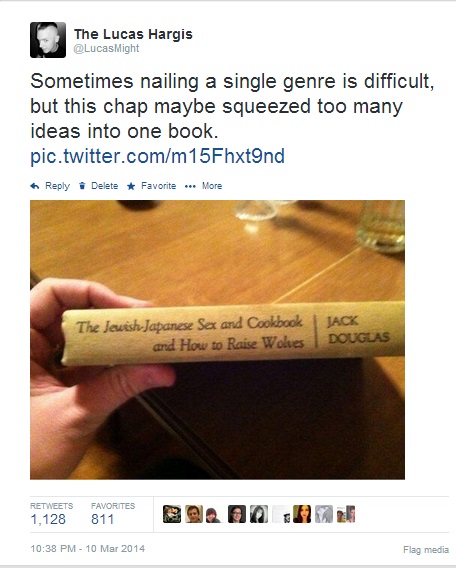
A random occurrence on Twitter had me both cringing & smiling this week. Also, head-scratching.
See that Tweet up ^there^? I posted it on Monday 3/10/14 at 10:38 pm EST. It received a few RTs that night, which ballooned the next day. And the next. It got up into the hundreds—I’m thinking around 300 or so RTs. And that was a complete aberration for me. My highest number of RTs before that was around 75 for a coffee-related Tweet shared in the morning. [Because coffee!] My How I Got My Agent link also received a massive amount of play. [Because writers!]
Everything quieted down with the Undying Tweet. I [mostly] forgot about the aberration and moved on. As one does. But it sparked some lingering questions in my mind:
– What made that one so popular?
– How can I repeat that?
– Is there a formula here, or at least attributes I can glean, to help craft RT-able Tweets in the future?
I’d already been reading quite a few articles on social media marketing. Stuff like the best days & times of the day to Tweet/blog/FB/Tumbl, the types of information that get the most interaction, etc. There’s an abundance of data and research findings. Here’s one such example: Best Time to Tweet
Before the Undying Tweet was born, I’d been intentionally playing with timing and content, tossing out test subjects—funny, serious, links, images—at different times of the day. I wasn’t super-scientific about it, but just intentionally varied the types of content and posting times. During this process, I stayed decidedly me, Lucas, but chose to tailor my content a bit for the test subject Tweets.
My non-scientific findings:
– Folks seem to like short, funny things in the morning.
– Image Tweets in the morning do especially well, but are golden anytime.
– Helpful links get good play in the daytime.
– In the evenings…beats me! I revert back to sharing whatever randomness pops in my mind or I stumble across. #QUASI-SCIENCE!
Back to the Undying Tweet.
I found that image on Tumblr. I switched venues and added my own insight. The author of that book, Jack Douglas, obviously titled it like a boss back in 1972. That made the image intriguing. Maybe my commentary had nothing to do with the success of the Tweet, but I’m going to pretend like maybe it did.
And, apparently, magickal streams of energy aligned and {{poof}} it grew wings, flapped around for a while, and eventually nested. Then, 3 weeks later, for some unknowable reason, someone, somewhere resurrected it. It bounced over to some guy with 50k followers who ended up RTing. Then others with 5-digits of followers. And it hit 500 Favs, so Favstar RTed it. The chain reaction just kept spiraling outward and it went quasi-viral.
The Undying Tweet hit 1ooo RTs yesterday afternoon, then nested again. I woke up to an influx of 100 more RTs this morning as folks on the other side of world picked it up and continued the signal boost. Again.
You better believe I’ve deciphered the hell out of the wording, the structure, the timing…
Based on some Twitter comments and questions, I get the feeling many of you have been doing the same. Because we all know that an occasional viral Tweet, when it could really help promote a book, for instance, would not be a bad thing at all.
In my ridiculously limited wisdom, here’s How To Create A Tweet That Won’t Die:
– Be intentional about varying your content & timing.
– Share stuff that interests you. Chances are, it will interest others.
– Keep the topics broad at times: food, books, movies, kitties (blergggh) for the most RTability.
– Add your own flare. What good is a signal boost if your brand isn’t lightly stamped on it?
– Use images.
– Believe in luck, magick, serendipity.
– Don’t stress over it, but like any other goal, continually experiment & hone that skill.
This has become an experiment at this point. The Undying tweet is currently at 1128 1133 1136 RTs and 811 813 816 Favs.
If you’d like to add to the magick, RT or Fav the infamous Undying Tweet by clicking here.
And I’m curious…
What patterns have you noticed?
What are the characteristics of your most Retweeted or Faved Tweet?
Do you believe Tweeting is a craft worthy of honing?
I’d love for you to share in the comments so we can keep deciphering the magick [as much as magick wants to reveal of itself anyway] together.
I’m feeling a bit ~quiet~ today, which is a thing that comes and goes in waves. You know those days where you turn a bit inward and think a little deeper on things than on most days.
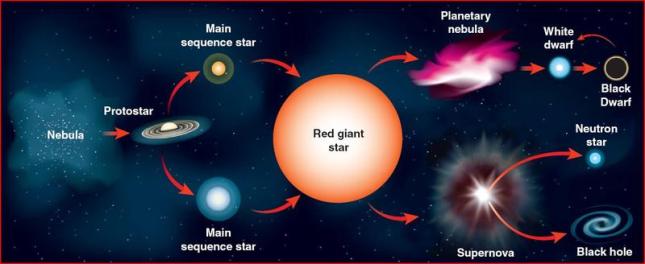
Today my thoughts are hovering over reality, expectations, promises [kept and broken], goals, forward motion, commitment, longevity, why some supernova collapse into blackholes while others morph into neutron stars. You know, light stuff like that.
When I drift into these moods, it’s nice to find other’s words to help express what I’m feeling. It’s part of the processing, I guess. A way to sort things out—simplify them—and ease back to a more outward existence.
“We do not grow absolutely, chronologically. We grow sometimes in one dimension, and not in another; unevenly. We grow partially. We are relative. We are mature in one realm, childish in another. The past, present, and future mingle and pull us backward, forward, or fix us in the present. We are made up of layers, cells, constellations.” ~Anais Nin
And a lot of times one set of words will lead me to another set, which may or may not be directly related but possesses this ethereal connection somehow.
And I seem to stumble upon the most random & interesting tidbits when in this mindset.
Described by one scientist as “the ultimate alchemists,” stars are pretty incredible in that they are these miraculous self-contained and proactive systems that, with the pure power of their own mass, produce the principle elements of life. Then, because all life is about connection, they clump together into star forming regions (or nebula), evolving, and turning themselves into new stars. ~ Lynn Johnson
So, yeah: growth and transformation and thoughts and stars.
The great thing about these ~quiet~ days is how they usually spark new ideas. They serve as those star-birthing nebulae. And they also help existing ideas, thoughts & emotions kinda coalesce. They’re as welcome as the ~loud~ days, and perhaps cherished because of their rarity.
Here’s to hoping you find that perfect balance of ~loud~ and ~quiet~ days.
A lot of times, my ~quiet~ days are triggered by hurt. Someone I trust, I’m close to, lets me down in some way. The processing is how I stretch beyond the hurt to forgiveness. Because nobody wants to be a blackhole.
I took my first train ride over July 4th weekend 2013. Cleveland >> Buffalo >> Toronto >> Return.
This trip was amazing for a ton of reasons: couchsurfing, TORONTO, the travel itself. A good portion of my quick turnaround four-day weekend was spent on a train. [Details here: http://wp.me/p2k31x-oA]
At that point, I was revising my novel Phreak Show and plotting Epistle Of Doff. I’m not sure if wi-fi is a thing on some trains, but there was no internet access on my trip. Translation: productivity.
A lot of you are already aware of the #AmtrakResidency Program for writers. If not, check out the origin story here: http://blog.amtrak.com/2014/01/tweet-lands-writer-best-workspace/
And if you dig the idea of a long distance train ride in a sleeper car [complete with desk], you can complete your own application here: http://blog.amtrak.com/amtrakresidency/
[I totally jumped on that thing the second I realized the application was live.]
During the application process you’ll have to confirm that you read the Official Terms. I’m [obviously] not a lawyer, but we writers are always concerned about works-related rights. Right? Right.
So, with that in mind, consider the clause in Item 6 of the Official Terms before selecting what writing sample to include with your submission:
6. Grant of Rights: In submitting an Application, Applicant hereby grants Sponsor the absolute, worldwide, and irrevocable right to use, modify, publish, publicly display, distribute, and copy Applicant’s Application, in whole or in part, for any purpose, including, but not limited to, advertising and marketing, and to sublicense such rights to any third parties…
Bear in mind that as part of the application, your submitted sample (up to 10 pages) falls under the above Grant of Rights. You know, not that that should hinder you in any way. Just something to weigh and perhaps aid in the sample selection process.
So my application’s in. With up to 24 possible slots with 1000’s [10,ooo’s ?] of applicants, it’s a long shot for any of us. But that’s okay, because an investment of 15 minutes time could end up in a 2-5 day train excursion. Pretty rockin’ tradeoff if you ask me.
Q: Who else is applying for the #AmtrakResidency?
Q: If you don’t score one, now that the concept is under your skin, would you self-fund your own train trip as a writing retreat?
I wear a ridiculous number of hats. [More metaphorically than in actuality, because I love my hair. I kinda treat it as living art.] One feather in one of those symbolic caps is this: I’m MS Certified in Word & Excel. Like, a certificate and everything.
Often, I see questions tossed out on Twitter: HELP! Does anyone know how to [insert formatting issue here]??? Also, when I CP, I find really strange formatting things going on and I’m all like: ZOMG this is a pain in the ass how do you even deal with this madness ahhhh let me help you please please I beg you no really I don’t mind please.
So, I figured, why not share a bit of the knowledge hinted at by that little certificate? Thus, as long as you loverly readers are interested & gaining golden info, I’m gonna do a series of Formatting Tips for Writers.
I use MS Word 2010. If you have a different version, or your toolbars are set up differently, feel free to comment below or hit me up on Twitter [@LucasMight] and I’ll gladly walk you through how to format with your specific setup.
Today: Inserting chapter breaks [with a delicious, free-of-charge side-dish of Chapter Navigation]. And if you already have a manuscript, you can easily go back in and apply these steps retroactively.
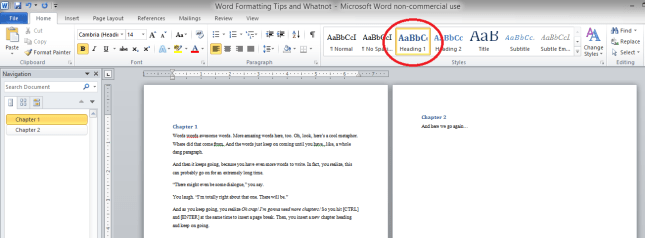
Step 1 – Choose a Heading Style: When you begin each chapter, select a Heading Style. [I choose Heading 1, then change the color to black.] Type your chapter title. Once you hit enter, the style will automatically revert to your default font style.
Step 2 – Insert a Chapter Break: Type your awesome words. After the last sentence of the chapter, hold down [Ctrl] as you hit [Enter]. This will insert a Page Break so your new chapter begins at the top of it’s own page. Even after you revise, add or remove words, it will forever stay where it should.
Step 3 – Use the Navigation Pane: Let’s fast forward. You have chapters with perfect page breaks. By using the Header Style, you also have another tool at your disposal. On the VIEW tab at the top, click the Navigation Pane checkbox. A list of chapters appears as a left-hand sidebar. This makes hunting down and navigating your chapters during revision/editing so fantastically easy. If you ever want it out of the way, simply uncheck the box.
There are a ton of tips and topics I’ve seen other cry for help on, or that make my drafting, revising, CP’ing, etc so much easier. The functions are there, and I’d love to put that damn certificate to good use by passing the wisdom on.
Do you have formatting questions?
Word issues that give you headaches & keep you from actually writing?
Things that MUST have an easier way to accomplish?
Let me know via comments or Twitter. MS Certified Lucas at your service.
:: tips hat ::
I love when hard-awesome things like this take place.
Writers supporting one another while expecting nothing in return. Just for the sheer joy of encouraging & celebrating.In that vein, I hope you keep spreading the love.
This is the Book I Can't Stop Thinking About
I’m in awe of authors. All authors. People who work hard to create a rich and textured story, and then work harder. And then even harder. And then do that about a billion more times.
And then they show it to the world. That scares the crap out of me.
A few months ago, it came to light that a writer friend of mine was thinking of releasing a book that sounded so freaking good that I couldn’t help but squee all over the place (which is to say all over twitter). It’s a novel that was really close to her heart, she said, but she was concerned. It wasn’t like the young adult novels she usually writes, the ones she’s known for.
It’s about two boys who fall in love. It’s called FALLING FROM THE SKY by the very talented Nikki Godwin.
It’s a book that needs to be…
View original post 467 more words
Confession: I have imagined my novel as a movie.
Now, don’t leave me standing here all alone, kiddos… This is pretty much a prerequisite for writers, right? Don’t blush or try to deny it. I’ve seen your Tweets. And your Pinterest boards. We’ve had conversations. You’re as guilty as I am.
I’m an extremely visual dude. When I write, the scenes play in my mind like a movie. I direct the characters in a sense, but the buggers improv A LOT.
Okay, eff it, I’ll even admit this: my friends and I sit around dream-casting my Phreak Show characters. And a few of you have even volunteered [okay…demanded] to help out on the casting call for Niko. Your amorous intentions are duly noted. [And he’s flashing his crooked smile at you right now.]
Yesterday, a non-writer friend I haven’t spoken to in a while checked in. Curious about where Phreak Show is in the process, the convo went something like this:
Dude: So what’s going on with your book deal?
Me: Not to that part of the process yet. Finishing edits with my agent and then we’ll move to the next stage.
Dude: Awesome! When do you get the book tour and 3 movie deal?
Me: [internal cackling] It’s super rare for books to actually become movies.
Dude: Then how are all these books becoming movies all of a sudden?
Me: [internal sigh] The % of books being made into movies is probably, like, 2%. Max.
Dude: Well those 2% are really getting lucky these days.
Me: [reminds self dude is a rube] No more than usual, I don’t think. And that still leaves 98% of authors dreaming about their books becoming movies, but it never happens.
Dude: Ahhhh, I see.
This kind of conversation happens all the time. So, obviously, we writers aren’t alone. It seems most folks naturally have this ingrained perception that book = movie. So I started wondering how close my random estimate of 2% really is. Enter: THE MAGIC OF GOOGLE
I submit for your enjoyment and education, the interesting [and perhaps sobering] info I stumbled upon.
First off, some hard-awesome checkpoints we can all keep in mind when writing our next novel or assessing existing ones. John Robert Marlow offers this list of:
This first stat sounds really promising. It’s estimated that:
http://www.kgbanswers.com/what-percentage-of-all-movies-made-in-the-usa-are-based-on-books/22949183
But how many books does that translate to? This poster doesn’t cite a source, so the accuracy is suspect, but states:
http://wiki.answers.com/Q/What_percentage_of_movies_are_made_from_books?#slide=2
I have no idea how accurate this stat for 2014 is either. I found numbers ranging from 10 to 35, but CNN reports these as “all the books becoming movies in 2014”:
http://www.cnn.com/2014/01/31/showbiz/movies/books-to-movies/
http://www.buzzsugar.com/2014-Movies-Based-Books-30889382#photo-33260882
So how does a book ascend to the coveted heights of filmdom? This great behind-the-scenes mechanics post explains:
http://andyrossagency.wordpress.com/2011/01/04/books-into-movies-everything-you-need-to-know-part-2/
But even if a book is optioned, there’s still no promise our friends, family, and fans can check out our stories on the big screen. Author Joseph Finder says:
http://www.josephfinder.com/blog/201101/26/how-a-book-becomes-a-movie-revisiting-high-crimes
And if you scroll down to Lesson 28 in this post, you’ll find this statement putting that estimated percentage even higher:
http://www.ian-irvine.com/publishing.html
Using IMDB & U.S. Census Bureau stats, this random gent [quite non-scientifically] calculates:
http://answers.yahoo.com/question/index?qid=20100818233541AA29WXH
Feels like a snowball’s chance, right? But, hey, we can’t resist hoping. Perhaps the most important thing in this entire post is something you already know:
That’s part of the how and the why we create characters, build worlds, and invent delicious plots in the first place. Our dreams refuse to die.
I guess, at our core, writers are optimists. And, for those of us who are really optimistic, we don’t stop at just dreaming. We finish manuscripts. We revise the hell out of them. We send query after query until an agent falls madly in love with our words. We revise again. Even when it hurts. We suffer with impatience during the submission process. We revise those words again with an editor. We do all these things because we are ridiculously optimistic.
We hope. And we dream.
So, honestly, we can’t stop dreaming about our books becoming movies. Even if we try uber-hard. It’s just not who we are as a species. And as long as our expectations are realistic, it doesn’t hurt a thing.
Besides, being dreamers, we always have that 2% or 1.77343% to hang on to. Even if the true number is only .00001% of books becoming movies, that’s more than enough to birth a dream inside us.
Q: What are the chances of your book becoming a movie?
A: Are you a dreamer or aren’t you?
[FTR, my answer to the question-posing-as-an-answer is: Incurably so.]
—
This vid inserted thanks to the genius inspiration from @EsherHogan
Once upon a time, I wanted to check out what my words would look like on a Kindle screen. I hunted down the process and created my own little cheat sheet. Since that time, I’ve seen others ask if it’s possible, and have forwarded these instructions to a dozen, thankful peeps. [Maybe you’re another one waiting to happen.]
So, should you want or need this capability, here she is.
Step 1: You should have an email associated with your Amazon account. If not, you’ll have to do that first. If so – go to Step 2
Step 2: Send an email to your kindle address. It will be the same as the email in #1, only with the @kindle.com extension [e.g. your.regular.email@kindle.com]
Step 3: The subject must be “convert”
Step 4: Attach your Word doc [You can attach MULTIPLE docs]
Step 5: Send that baby!
Step 6: Log into your Amazon account. Click “Personal Documents” on the left-hand sidebar
Step 7: It usually takes 2 – 15 mins of refreshing for the file to appear.
Step 8: Once it does, click on the “Actions” dropdown next to the file name.
Step 9: Select “Deliver to my…Kindle”
Step 10: On your Kindle – “Sync & Check for Items.”
VOILA!
Useful for:
– Personal encouragement. Just seeing your created words in that format can give you a dreamy, little boost.
– Handy access to your own words on-the-go. [You know, just like any other e-book.]
– I find errors that somehow remain invisible on both the hardcopy & computer screen.
– It keeps you from editing as you go. So you can just read. [If I find something major to change later, I scribble a key phrase on a notepad & later do a search for that phrase in the Word file.]
– [Insert your own amazing reason here]
Other tips:
– Insert an image on the first page of the file & it will display as the book’s cover.
– Others, such as beta readers, can forward the file to their own Kindles. [You know, once you pass these instructions on.]
– If your betas/CPs are comfortable with it, they can even authorize your email on their Kindle account & you can send it directly to them. They just have to pick up at Step 6 above.
I’m curious about those of you who use programs other than Word or have different readers/apps.
Do you ever use a similar process? Know of a quick cheat sheet to help others do the same?