Get With It, Boy Wonder


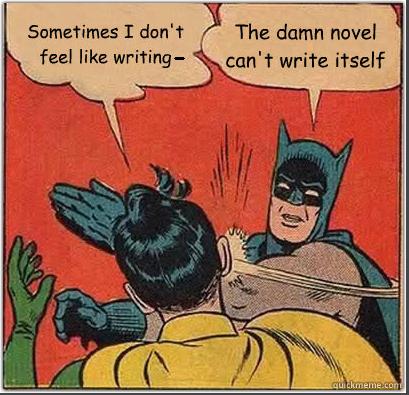
BatmanSlappingRobin

Not that I’m gonna start jam-packing my blog with memes & gifs, but I was somehow moved to create this dandy yesterday.

Apparently, the slap from the caped crusader worked. Yesterday, the writer in me stretched and yawned and came out of hibernation. I read through the last 3 chapters I had written for Phreak Show to get the style/voice/continuity back. Here’s what I found:

1) The story is still rockin’. Even if I hadn’t written it, I would totally read it.
2) It is so so so so difficult to simply read a draft and not edit. Despite my best efforts, I absolutely had to scribble a couple minor notes…
3) I was able to jump right back into the rhythm. Even after stepping away for 6 weeks. So, another chapter is written and the final few will quickly follow.

The seal on the writing cave has been [re]opened.

Because, after all, the damn novel can’t write itself.

Alfred, go get me some more coffee.

Action! [And Invisible Ink?]


Oscars

Being burned out is different from needing a break.

Other than brainstorming for some flash fiction, I haven’t written for six weeks. [Unless you count writing checks for bills or revising my résumé. Shite. I haven’t even been blogging as regularly as I ought.] That is by far the longest non-writing spell I’ve had during the last 2 1/2 years.

It’s odd how the process for Phreak Show has been so different from my previous novels. As always, the premise & ideas developed over time. They simmered and congealed in my head for months. I scribbled a few gems down so as not to forget them, but then held all that info in a sort of suspended animation in my head. In a moment of weakness, I drafted and revised the opening page before a conference.

And then I made myself stop.

I was holding out for NaNo. I remember dying to get the words out. The characters were yapping all the time–developing and morphing and becoming folks with their own rich, private histories. I’ve never been on a movie set right before filming begins, but that’s what I felt like was going on. The actors were getting to know one another, practicing their lines, feeling one another out. Alliances and enmities were formed. Flirtations began. Evil eyes were cast.

Then the planning and gap-filling for the novel took place. November came, and the mad, loose drafting started. I hit my personal goal of 60k by Thanksgiving. And without backtracking, reading, or revising, I set the world aside.

And then I made myself stop. Again.

I haven’t touched it since. And that is something I’ve never done before.

Normally I blaze through the first draft, maybe take a few days off at most, then dive back into revising the story. Not so with Phreak Show. I didn’t lose interest in it. I definitely didn’t burn out on the characters or the storyline. I didn’t lose steam or get stuck on which way the tale would turn next. There was something about how well the narrative was going and how amazing everything was coming together that made me not want to screw it up. Or something.

Is  it a line from a movie or a statement from an actual friend I’m remembering right now? Something about a guy getting his hair cut three days before a wedding so he would look well-groomed but not like he had gotten his hair cut the day before? That is where I’ve been with the drafting of Phreak Show. Another hair analogy [what’s with all the hair?] which comes to mind is planning a dye job a few days before an important event. That first day, the new color is screaming and vibrant. But almost too vibrant. Know what I mean? Like the fiery-red needs to chill out a minute, rest, relax, calm down, age, mellow, whatever.

Phreak Show has been doing all those things.

But, the characters are stirring. The break is over and the cast members are stumbling back onto set. A few are groggy and apparently hungover. Others are chipper and almost too eager to slip back in front of the camera. The propmaster is dusting off the creepy specimens in the Odditorium. The gaffer is ensuring that the sideshow’s Tesla-inspired lighting system is ready for night taping.

If I’m going Paparazzi-Reporter for a minute, I feel compelled to divulge that Tera, in particular, is battling with her nerves. She has recently discovered her new role in the twisted plot and really wants to nail this next batch of scenes. [Sources say she is deadset on an Academy Award this year.] And the growing connection with Niko? Well, they’re both remaining silent on the topic, but they were recently spotted with their lips locked beneath the downspray of a public fountain in Savannah. Not exactly a platonic co-worker kind of move.

So, the stage and actors are ready. So is the Director. I have the loft all to myself for the next 5 days. Guess what that means? We’re gonna finish shooting this thing. Just a few final scenes–jam-packed with emotion, action & major sacrifice–and then we’ll wrap it up and head to editing.

Wish us luck. Tell us to ‘break a leg’ and all that. We’re going back in.

Ahhh! Finally, some more invisible ink. While the “ACTION!” has been slowly building in my throat and moving to the tip of my tongue, a recent event has smacked my back and made me spit out the word. A few days ago, Lit Agent Louise Fury followed me on Twitter. Out of the blue. Like, I haven’t been talking about writing or #PhreakShow or anything. In fact, in the thrust of the holidays and a general hiatus from all things writerly, my Twitter presence has diminished of late. I previously queried her with two other projects and I’m sure I was following her at one point. But when I checked, I had to ‘Follow’ her again. So, I thought the whole thing was interesting, but didn’t revel too much in the thought.

Then, today, I got notification that I had a new comment on the Phreak Show page of this here blog. Guess who it’s from? Yep. Go check it out.

100 lbs of Tacos


Choose the Tacos

Choose the Tacos

You know that old joke-riddle:
Which weighs more, a hundred pounds of feathers or a hundred pounds of hammers?

The first time we heard it, our minds instinctively ran to the common-sense place where quickthink logic superseded actual logic. Hammers are way heavier than feathers. So, hammers weigh more.

But then we realized: No, dumbass, 100 lbs is 100 lbs.
The hammers and the feathers weigh the same.

Tricky.

Let’s extrapolate that a bit. I wonder how often that common-sense, quickthink logic overrules the better, more accurate kind in everyday life. I’m guessing a lot.

How many decisions do I make throughout a day where I come up with a quick, logical answer and run with it? What if I had slowed down and weighed that decision to make sure it was the best one–the correct one–instead of merely the quickest one to pounce on me and dig its claws in?

Hammer answers come quickly enough.
And a lot of the time, they are wrong.

[Now, I could very easily branch off here, take the idea of ALL THE CHOICES and go into thoughts on multiverses, many-world theory, and the like. But I won’t. I’ll focus. I just wanted you to know that I weighed that decision and chose not to take that path.]

So, decisions/answers/choices. The first one to pop in my head is not always the best one. I’m guessing the same is true for you.

George punches you in the nose.
Stunned, you blink through the surprise, tears, pain, and anger to confront the asshole.
He says, “Your move. What you gonna do next?”

Visceral responses flash in your mind: uppercut, leg sweep, groin kick, fist to the throat, chainsaw.
Then [maybe] your pulse slows and you try to remember why George punched you in the face in the first place.
Maybe you shouldn’t respond with hammers, but with feathers.

Or maybe both those answers are wrong.

I still hear folks being all butthurt about writers writing blogs about writing.
Cater to your future readers and fans. Build a fanbase of non-writers.

That shit is whack. I make this choice: to write what I want to write about. And, right now, I love writing.
So, I choose to write about whatever pops in my head. And often, like today, those thoughts drop breadcrumbs towards the topic of writing.

Like this: I make my characters not choose the answer of “hammers”.

1) It is wrong
2) It is boring

When drafting a scene, obvious choices appear for the characters. I could easily enough have them follow that path down the predictable. But it is so much more fun to have them go another route. I ask: What if they chose feathers instead? Or what if they got the answer correct and said “neither”? Or what if they said, “Eff the feathers and the hammers. My answer is tacos.”

This kind of character decision-making makes for a much better story. More excitement. More punch. More tension.
Nobody wants a snotty MC who always gets it right–who always makes the safe, correct choice. We also don’t want them to make the wrong choice if it is glaringly obvious that they most likely will.

In other words, take the time to weigh the choices at decisive moments in your narrative. Sometimes, you might need to go the feather route, sometimes the hammer and chainsaw way, sometimes send your characters down the path of 100 lbs of tacos.

And don’t stress, the revision stage is where you can explore the multiverse idea of the path not taken.

[Ha! I slipped the topic back in again. Because I chose to.]

CHOOSE ALL THE TACOS.

NaNoWriMo Month-Long Updatable Update


As part of my #NaNoPrep, I’m hacking in this roughshod post before the clock strikes midnight. Since my main focus over the next 30 days is to knock out the first draft of Phreak Show, I don’t want to waste words anywhere else. [Well, Twitter is–of course–an exception.] And a month of non-blogging is equal to child abandonment in 36 countries.

So, here is the skeleton. If all goes well, I’ll distract myself with an update once per day–slipping it between changing out my coffee IV bag & maybe a birdbath. [Because a month of poor hygiene is punishable by a public hosing in 28 states. Plus the District of Columbia.]

<— The widget over there should track my word count and % progress towards my goal of 60k. So, I’ll probably post each day’s total, perhaps an excerpt sentence, hopefully some epiphanies, and probably some whining–which is to say: venting leading towards more productive creativity…

Let the 30 days & nights of literary abandon begin.

Day 1 – Kicked off NaNo 2012 with a midnight write-in with the local Wrimos at a Steak & Shake. Churned out 632 words in the word war waged during the first half hour. Via three more sessions today, I ended up with 6,332 words added to Phreak Show. Breaking the 5,000 mark earned me a celebratory pack of Rolos. And, like a good boy, I made sure to back-up the file in all the places.

Day 2 – Words added: 2,795. Around 1 a.m. I had to comfort a friend with relationship issues. Friend duties completed, I whipped out a few unexpected paragraphs, then finally crawled into bed. A few more sessions throughout the day. Leaving #PhreakShow on pause at this upcoming scene: Tera is entering a unisex shower where she will encounter Shim the Gender Enigma. [Spoiler Alert! Shim is feeling frisky…]

Day 3 – Started the day with some early writing fueled by mucho coffee . Traveled 30 minutes east for a write-in [and more java] at an independent bookstore. Apparently, Chapter 6 decided to be hot & steamy & full of sexies. “So, are you ready to check out my crotch? Turn your guess into a known fact?” Ahem. 3,528 phreaktastic words added.

Day 4 – A little morning writing gave way to putting the final touches on a few new furniture pieces. Then, more writing. Enmeshed within today’s 3319 words is a bit more unfolding of the first page hook. Emotional? Yes. Today’s section also contains the official ‘1st Plot Point’ of the 4-Part Story Structure–right on schedule. Chapter 7 ends [as all chapters should] with an absolute, no-doubt-about-it, must-stay-up-even-later-to-read page-turner…

Day 5 – I was able to churn out a quick bit of writing before the day’s madness began. After a ton–as in, a marathon session–of cleaning, Micah and I hosted our first writing and art salon of the season. We had a dozen folks come in and out through the evening. [It’s after midnight right now & 5 us are still creating.] The artists seemed to have made more progress than the writers. We’ll get ’em next week. 3,161 words for the day. 19,028 for November. Total wordcount for Phreak Show: 24,868.

Day 6 – Writing. Packed the van for a show in Atlanta. Writing. Voted. Writing. Distracted by election results rolling in. Also, the insanely active buzz of Twitter. Impromptu :15 word war with some Tweeps. Checked election results. A tiny bit more writing. In the midst of all that, I somehow added 2,380 words, thus breaking through the 20k barrier. “Spanish moss dangled from the trees like stringy, gray clumps of witch’s hair.”

Day 7 – Most productive day since the kick-off. Was able to focus on writing throughout the day and landed 5,022 words. At this rate, NaNo tells me I need 983 words per day to hit 50K by the end of the month, I think I’m on my way to a “win”. The Phreak Show rolled into Savannah this morning and set up at Forysth Park. Part of it looks something like this: 

Day 8 – Added 3,633 words today which arced me over 30k. I’m halfway to my personal Nano goal. And that damn Tera made me cry today. I wrote steadily through the early hours which left me time to check Phreak Show’s pulse this evening. This included spending some time with my planning notes to make sure I’m on track, and refreshing myself with My Guide to Not Sucking: https://johnlucashargis.wordpress.com/2012/10/24/my-guide-to-not-sucking/  All is well.

Day 9 – Wowserz! Somehow I managed 5,088 words today. They came in fits and starts. Maybe, idk, 4 times, I stepped away, thinking I was done for the day. But when I sat back down and read the last few lines written, I found myself clacking away at the keyboard again. Go figure. Today, one of the exhibit tents gained a new name: Phantasmagorium. Here’s a line: “A pro wouldn’t show up to work in secondhand, old-lady-smelling pajamas.”

Day 10 – Writing traveled at a slower, more deliberate pace on Day 10. Drafted an all-important transition scene which ramped up to the next one: an experience which alters Tera’s entire perception of what is happening in the Phreak Show. The Big Twist is coming up 2 short chapters from now. Have to prime the chute. 2188 words.

Day 11 – 3,475 words and I think I’m done for the day. Maybe. The story is flowing along phantastically. Today’s scenes involving revelations regarding how ingrained the phreak images are within the teens–just, wow. I broke 40k. 20k more before Thanksgiving is looking like a goal I can definitely accomplish.

Day 12 – It’s funny how most write-ins end up more about chatting than actually writing. The writer/writer interaction provides for a much-needed break in the solo endeavor, so it’s welcome. I added 150 words during a 3.5 hour write-in last night. It didn’t boost the wordcount all that much, but it was fun. Total added: 2,881

Day 13 – Some writing in the morning, some writing in the afternoon, a duel with the NaNo Municipal Liaison for my region…all led to 4,149 words today. From here on out, I need to average 120 words per day to hit 50k by 11/30. With only 2,156 left, I’m pretty sure I ought to be able to hit that “WIN” tomorrow.

Day 14 – I’m eating a Special Dark. Because I added 2,590 words today. And because of this:

Day 15 – Took a roadtrip to Michigan and was able to hammer out a few words while in the car. 2,013 added for the day.

Day 16 – Added more words on the ride home, and then a few more late in the evening. Scored 1,902 additional words. Hoping to pick the pace back up over the weekend.

Day 17 – Another low wordcount day. [Compared to my 3500+ average.] Scraped up 1,783.

Day 18 – And…back on track with where I want to be as far as daily wordcounts. Added 4,274 on this lovely day. Also, if you check out that widget over at the top of the left-hand column on this here blog, you’ll see that I hit my 60k. Rock.on.Lucas. That was the goal I wanted to hit by next Thursday. I blazed past it, so any words I add between now and the end of the month are just extra gravy on the stuffing.

Day 19 – Zero, nil, zip, zilch words. And proud of it! Took a well-earned day away from writing to focus on some art.

Day 20 – 1,883 words added today. Left off at a great cliffhanger. Which is to say, set myself up with an excellent starting place for the next drafting session.

Day 21 – You have no idea how good these zero wordcount days feel! If I wasn’t at 60k yet, I’d be all: No! Oh no, oh no. Must right the wrong. Must write. Must meet goal. Ahhhhh! But, since I have accomplished what I set out to do, not writing a thing for a whole day comes with the greatest sense of satisfaction.

Day 22 – Churned out 1,767. Even on Thanksgiving. In the morning. Before mass quantities of turkey were inhaled.

Day 23 – Day 29 – Yeah, so no daily updates during this period. I wrote and edited a little, but at a leisurely pace. Once I rolled up and over that hump, I needed to move away from the drafting for a bit. So many other things going on right now.

Day 30 – The final day. I definitely hit my goal–and them some. Current wordcount for Phreak Show = 70,055. I need another week of focusing on other things before diving back in. The crux of the final 7 chapters is fully formed. I’m letting the characters act them out in my head so the drafting will flow out in all its gloriousness.

Countdown Apocalypse


I have suffered through some horribly cheesy movies of late. This is mostly due to 3 things:
1) Free ‘Premium’ channels on Dish [I set the DVR to record anything that sounded vaguely interesting.]
2) Halloween [Yeah, apparently ‘scary’ and ‘stupid’ are supposed to go hand-in-hand?]
3) NaNoWriMo [Waiting for the 11/1 kickoff, I’ve been wasting time doing things other than writing.]

To be honest, there is a 4th cause to the cheesy-moviethon: I like them. Actually, it’s not that I like suckhole movies. I really do abhor the thin storylines, contrived plots, flat characters, and horrendous dialogue. What I ‘like’ about them, is picking apart all the wonky, god-awful elements.

Last night I watched some stupid flick titled Countdown Apocalypse or Apocalypse Countdown or some such. The supposed apocalypse was utterly, utterly lame. And I never did experience any sort of countdown. The bulk of the movie was some chick wandering around–always moving–in a plane, walking across the desert, navigating the streets of Old Jerusalem, in a car between cities, hiking up stairs in a building, wandering aimlessly down long hallways, etc. Seriously, laid end-to-end, the main character’s footprints would wrap around the equator seven times.

During all this slow walking and uneventful travel, there was no dialogue. Like, at all. Instead of meaningful words to let me in on the lady’s state-of-mind or how horribly distraught she was over her daughter being kidnapped and shipped off to some antichrist processing facility in Tel Aviv, I got to enjoy symphonic music which–I am reckoning–was supposed to cue my feelings. Or something. It just made me sleepy.

About 15 minutes in [translation: 10,987,789 footsteps already traveled], it struck me that only 10 lines of dialogue had been spoken. The main character, Allison, spoke very little. And when she did, 90% of the time it was in the form of a question. Seriously. Lame. Watching with a friend, of course, we started shredding the movie’s suckiness. My job was to simply announce “Question” each time Allison posed one. While the pace of my job was uber-leisurely since she hardly ever spoke, I soon grew tired of hearing my own mouth say the same word each and every time she delivered a worthless line.

My buddy’s job was pointing out every time a character said something one moment only to contradict it in the next breath. Not as some form of characterization, but as [idk the hell what!] perhaps a failed attempt on the part of the writer to infuse tension? Maybe?

So here is how I would write in the style of Countdown Apocalypse:

Allison wore her tanktop which plainly showed the backwards culture that she was a hot, blond American MILF. She walked to the foreign taxi. Although it should only have taken 3 seconds, the journey took days. Slow emotional music echoed in her head.

“Can you take me to Jerusalem?” she asked.

“No. I am on my break. Well, okay,” the cabbie answered.

She rode along over a barren landscape which stretched out for millions and billions and trillions of miles. She stared out the window looking neither sad, nor bored, nor scared, nor anxious. But the somber tune continued to echo all around her. After 40 days, she arrived at the hotel.

“Did my husband check-in?”

“No, he did not. Oh wait, yes he did. Yesterday.”

“Was my daughter with him?”

“Yes. I mean, no. He was alone.” The innkeeper paused as Allison grimaced with horribly acted, false sadness. “Here, have a tissue, you sad American lady. Oh, prophets! The box is empty.”

“Can I have the key to our room so I can put away my stuff even though I will never pay attention to it for the rest of this boring ass movie?”

The innkeeper searched the desk, his pockets, the empty Kleenex box. “I’m sorry, it seems I have lost the spare key. Wait! Here it is. It was waiting right here with this important envelope I was supposed to give you. Enjoy your stay!”

“This hotel has a staircase, right? Would you mind if I took it up to the 785th floor so I can stare at the unopened envelope for 45 minutes as I climb?”

“No, I’m sorry. We only have an elevator.”

“Then what is that door with the stairway symbol?”

“Oh, I guess we do have stairs after all.”

“So you mind if I take them? How are the acoustics in there? Will the sad music effectively emote for me since I don’t have the capacity to do it for myself?”

The innkeeper nodded his head in slow motion to indicate that the sound in the stairway was awesome. “No, the sound in there is horrible,” he said.

Allison ate up 20 minutes of screen time, eventually reaching the door. Pausing, with her hand on the knob, she spoke through the wood, “Isn’t there some kind of countdown I should be worried about? Shouldn’t I be racing to save my daughter before it’s too late?”

The door stood silent. But the music droned on.

I won’t even go into the contrivances, false tension, lack of real plot or resolution, or the stupid ending I waited 6,500 hours to discover. What I will share is that I don’t understand how ‘stories’ such as these become actual movies. It really baffles me.

Going into NaNo–the 4th cause of me watching this P.O.S. in the first place–I am extremely aware of the need to avoid dead scenes, empty space, and groan-worthy dialogue. Also: stereotypes, dangling elements, lack of emotion, a pretend ticking clock, and subplots which go nowhere. While I was already well aware of those pitfalls, this fustercluck of a movie drove all these points home. So, maybe it’s a work of genius after all? Ummm…

“Why, oh why, do I subject myself to this crap?”

:: Cue heartfelt, symphonic music as Lucas trudges ever-so-slowly towards November ::

Current countdown to NaNo at the time of this posting: 15 hours, 12 minutes, 58 seconds

Lovecraft on Weird Fiction


When I say that I can write nothing but weird fiction, I am not trying to exalt that medium but am merely confessing my own weakness. The reason I can’t write other kinds is not that I don’t value & respect them, but merely that my slender set of endowments does not enable me to extract a compellingly acute personal sense of interest & drama from the natural phenomena of life. I know that these natural phenomena are more important & significant than the special & tenuous moods which so absorb me, & that an art based on them is greater than any which fantasy could evoke—but I’m simply not big enough to react to them in the sensitive way necessary for artistic response & literary use.

— H.P. Lovecraft in a letter to E. Hoffman Price (29 September 1933)

Lovecraft’s use of the term ‘weird fiction’ is not in a generic sense, but actually refers to a genre-of-sorts. Weird Fiction is akin to a sort of a ghost story/horror/macabre vibe separate from what we call fantasy or sci-fi, and was used from the late 1800’s to roughly the 1930’s, before these niches were labeled.

He was a moody, reclusive chap with some definite issues. So, this ‘confession’ could very well be a true admittance of weakness. But, unless I am mistaken, I get a sense of low-key sarcasm and reverse-projection hidden in the subtext. Lovecraft’s quiet, high level of self-efficacy in these words is quite beautiful to me. He’s saying one thing, but I believe it is subversive, and he is meaning quite the opposite. Of course, that’s just my take…

My Guide to Not Sucking


You can invest your very soul in writing a whooole book. And, in the end, it can suck.

Writing is a talent which is innate to many of us, but like any other skill, it must be developed and honed. Phreak Show is either my 3rd or 4th novel–depends on which way the tally is done. I do not want it to suck. So, I have been reading the ‘competition’, as well as books on writing craft. To further polish my grasp of this seemingly simple [bullshit!] craft of writing, I constantly explore relevant blogs, and even dished out the dough and attended an SCBWI conference last month.

And I feel far more prepared, knowledgeable and humble this time around.

Along the way, I have collected bits and pieces of advice, tips, keys, and ‘secrets’ to crafting an amazing novel. Finally, I have them all typed up and congealed into a single, personal reference file. These have come from all the above mentioned sources, but I admit I have been lax in recording the attributions. I’m guessing a lot of these tidbits came from Donald Maass’ Writing the Breakout Novel. Most of them, I have paraphrased or rewritten in my own words so they make sense to my specific brainwaves. I can’t claim ownership of any of these nuggets, but I hope they offer you the same bit of guidance they offer me.

THE BIG PICTURE

–          The essence of story is conflict.
–          The mind doesn’t know the difference between an imagined thing and a real one.
–          Above and beyond setting, characters and plot, great novels alter our way of seeing the world. Amazing novels do not leave us feeling neutral; they rattle, confront and illuminate.
–          Throughout every scene and twist, steer away from the obvious.
–          The time-tested development tool of asking “What if [insert alternate option here]?” while creating, offers a way to escalate stakes, add layers to plot and character, and open new thematic dimensions.
–          We read fiction not to just see ourselves, but also to imagine ourselves as we might be.
–          The moment tension slacks off, so does a reader’s attention. Include tension on every page to keep the reader glued to your story.
–          A well-constructed scene has a mini-arc of its own: a beginning, rise, and climax [or reversal] at the end.

PREMISE

If you do not start with a strong premise, your story is doomed to be mediocre. A great premise should contain these key ingredients:
Plausibility: It should contain a grain of truth, come from someplace real. It should be surprising yet credible. Readers will be concerned about the outcome of the story if what is happening to the characters could happen to them.
Inherent Conflict: Where there is conflict, there is rich soil in which to plant a story. The world should have strong conflict woven into its very fabric. (e.g. Strong opposing forces—perhaps both in the ‘right’)
Originality: Steer away from the obvious. It is essential to find a fresh angle, an unusual perspective. This often involves tapping into a previously unexplored aspect of a familiar subject.
Gut Emotional Appeal: Create a premise with a strong emotion built in. It should feel personal, and touch emotions that are deep, real, and common to us all.

STAKES

–          High stakes yield high success. Make the stakes in your manuscript as high as they can possibly be. Escalate the stakes. Put more at risk—much more.
–          A combination of high public stakes and deep personal stakes is the most powerful engine a truly amazing novel can have.

CONFLICT

–          What makes a novel memorable? Conflicts that are deep, credible, complex, and universal enough that a great number of readers can relate.
–          Having your protagonist face a moral choice is one of the most powerful conflicts any novel can present.
–          Push your central problem far beyond what any reader might anticipate or imagine.
–          Conflict must undergo complication. It must twist, turn, deepen, and grow. Make it deeper, richer, more layered, more unavoidable, and more inescapably true.
–          Use mystery. Between what we are supposed to know and what we do know—questions unanswered—there is tension.
–          When conflicting ideas, values, or morals are set against each other, it grips our imaginations because we ache to resolve that higher conflict.

CHARACTERS

–          Readers identify primarily with one strong, sympathetic character. It is this character’s destiny about which they most care.
–          All great characters are larger than life. They act, speak and think in ways we cannot. They say things we wish we had said and do things we dream about doing. They also express for us our greatest purposes and deepest desires. They are us. That is the reason we identify with them.
–          Great main characters are principled, opinionated, and passionate. They do not sit on the sidelines. They act.
–          The characters in your story will not engross readers unless they are out of the ordinary. Identify what is extraordinary in otherwise ordinary people.
–          Every protagonist needs a torturous need, a consuming fear, an aching regret, a visible dream, a passionate longing, an inescapable ambition, an exquisite lust, an inner lack, a fatal weakness, an unavoidable obligation, an iron instinct, an irresistible plan, an undying hope…Which of these defines your main character’s motivation, drive, and inner turmoil?
–          Depth is the secret to memorable characters. Fully rounded, 3-D characters have many sides, complex motives, and act in ways which surprise us.
–          Test your characters’ principles and strongly held beliefs to the uttermost. Push them to the extreme.
–          Push your characters to the edge. Be willing to make your protagonist suffer. Kill his/her ally. Take away his/her greatest asset. Undermine whatever s/he holds sacred. Shorten the amount of time in which s/he has to solve the main problem.
–          A character’s stakes will resonate with the reader only to the extent that the character is sympathetic. When characters are strong and appealing (better still, portrayed warmly and with intimate candor) the stakes feel high, and readers’ interest also runs high.
–          Self-sacrifice is the highest form of heroism. It is the ultimate expression of love and, as such, is about the most powerful action a character can perform.
–          The guiding principle of cast construction is contrast. Secondary characters are most useful when they disagree or produce friction with your main character. Or, even better, add unforeseen complications to the main problem.
–          Combine roles in the cast whenever possible. (e.g. A lifelong friend can also be the doctor, an ex-lover can be the antagonist, etc.)

PLOT

–          “Setup” is, by definition, not story. It always drags. Always. Leave it out.
–          A great story involves great events. In the course of the story, your characters must find themselves in unusual, dramatic and meaningful situations.
–          The central problem generally grows and grows until it seems to have no solution.
–          Ask: How can what is happening matter even more?
–          Ask: How could things get worse for the characters? When would be the worst moment in the narrative for them to get worse?
–          Striving to attain the impossible is a struggle from which we cannot take our eyes.
–          To lend an enlarged perspective—a sense that the universe is paying attention to what is happening—shatter or protagonist with a tragedy, or give him/her an unexpected gift. These things happen in real-life. Little miracles become our personal myths.
–          Consider motivating your main characters in complex ways. Put them in situations that are difficult, but in which the right path is not obvious.
–          The promise of transformation is what gives the journey of self-discovery its deep-rooted attraction.
–          Narrative momentum resides in the main plot; subplots put on the brakes. The scene following a high point is often a good place to introduce a subplot scene.
–          Subplots should only be included if they affect the outcome of the main plotline. If it complicates, bears upon, mirrors, or reverses the main plot, then it adds value. Otherwise, leave it out. It is dead weight.
–          Great plot twists stem from a sudden elevation—or fall—from one level to another.
–          Climaxes are both inner and outer, both plot-specific and emotionally charged. The payoff needs to fully plumb the depths in both ways if it is to satisfy.
–          The secret to a strong ending is allowing your protagonist the continuing possibility for failure.

SETTING

–          Either relegate it to the backseat or make it the chassis on which everything rides. But DO NOT ignore it.
–          Create a fictional world that exists convincingly, wholly, and compellingly apart and unto itself. The best novels sweep you away, whisk you into their world, transport you to other times or places, and hold you captive there.
–          Include specific, unique emotional responses to places. This is the secret ingredient in making a setting breathe. Also, show the change in the character’s emotional response to a particular place over the course of the novel.
–          Bring your characters alive in a distinct place and time which is alive itself: period, culture, human outlook, historical moment, spiritual mood, etc.

So, there you have it. A list of truths I am using to try my damndest to keep Phreak Show from being a mediocre suckfest. There are lots of other pointers swimming in my head along with the ideas. And I am hanging the novel on the framework of 4-part story structure, infused with concepts of The Hero’s Journey. We’ll see how it goes, but early reports indicate that–so far–this 3rd [or 4th?] novel doesn’t suck.

Character Cabinet Cards


The basic outline for Phreak Show is done. The first chapter is complete and in the hands of betas & CPs for feedback. I am letting the characters & storyline bounce around in my subconscious until 11/1. On that illustrious date, I will kick the drafting into overdrive as part of NaNoWriMo.

What to do in the meantime?

I know! Create an ‘antique’ cabinet card for each of my characters:

This slideshow requires JavaScript.

This was a fun process. And while it may seem like a waste of time, as it relates to writing, it is further reinforcement in my own mind that these characters are about to live. They are as real as they can be. They each have a story to tell. And Phreak Show is the vessel which is going to allow that to happen.

I do feel bad for Douggie, though. He doesn’t have a cabinet card yet. The source image I have for this character is perfect. It is Douggie. Unfortunately, it is cropped in such a way that it doesn’t lend itself well to the cab card construction. I’m still chewing on what to do about this.

In the meantime, I continue to live with the characters & pin more paper strips to the plotting wall. November is coming quick. Soon, these lovelies will begin to breathe. And presented in this uniform way, they really are beginning to feel like a team–a sideshow troupe ready to hit the road as The Last American Phreak Show.

The Plotting Wall


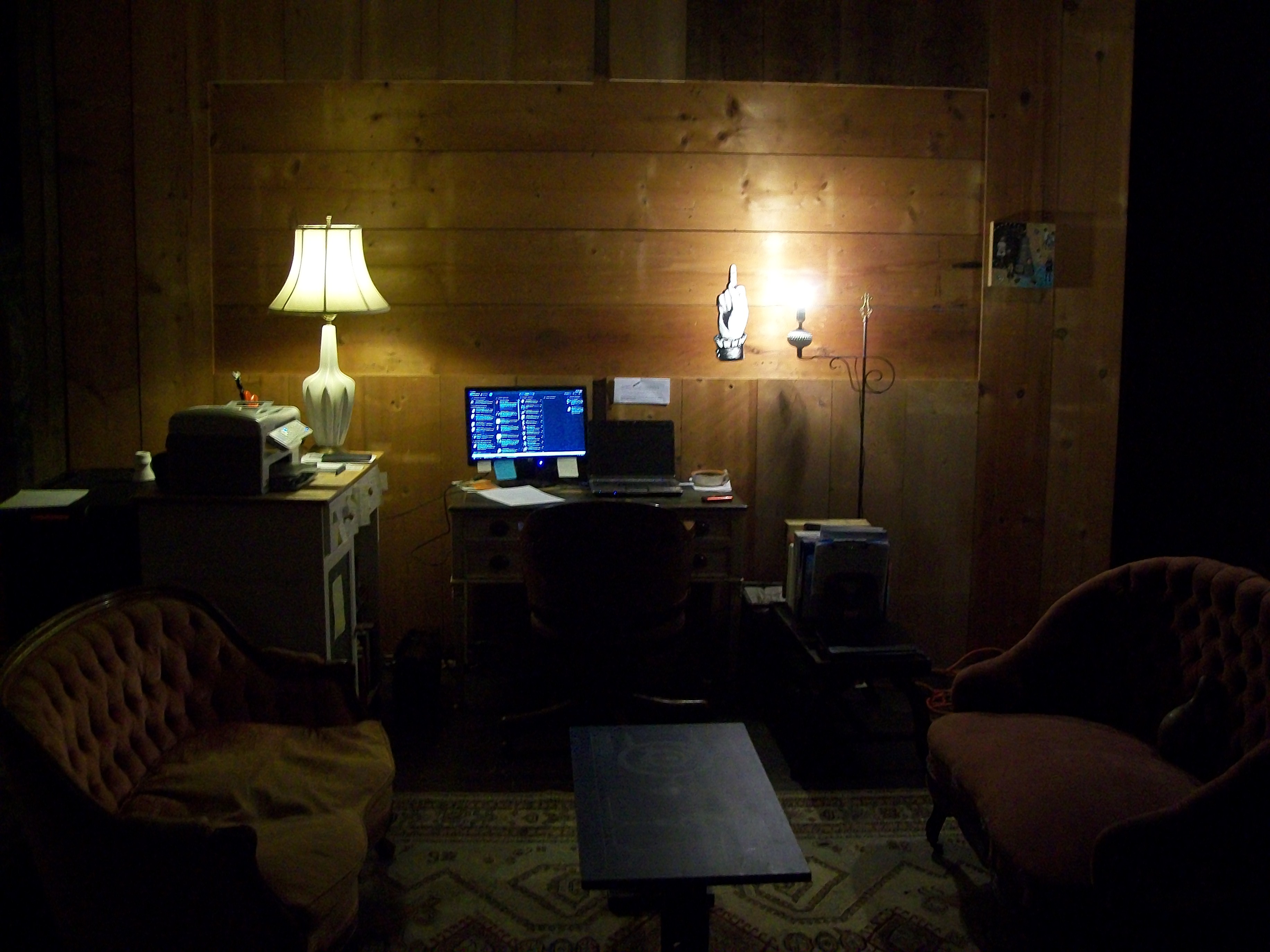
This was my writing nook earlier this evening: ambient, cozy, uber-organized & highly functional. But that focal wall behind my laptop was looking a bit empty. Too empty, in fact, with me being so close to beginning the first draft of Phreak Show. So I printed out some of my OneNote plotting info and turned that blank wall into this:

Now I have a visual reference for the major elements: call to adventure, refusal of the call, crossing the threshold, plot points, pinch points, mid-story twist, climax, etc . There are also setting notes, conflict opportunities, specific scenes, and random lines thrown into the mix. Over the next two weeks, these strips will move around, and probably triple in number.

I’m a very visual person. This set-up grants me a bird’s-eye-view of the story. When I begin the actual drafting, I will mark through each reference with a highlighter as it becomes part of the story. Maybe it’s silly, but I like seeing that colorful progress. It motivates me to keep going. I used this process for the first time when I wrote Freeborn. As I got into the thick of it, I knew I would use it for every future novel.

One tool I didn’t utilize with Freeborn, but am using with Phreak Show, is character cards. I created one of these for each of my named characters:

While I have all these in a digital file, I wanted to hang them right in front of my face—like an open photo album. Historically, Victorian sideshows had at least 10 attractions; more commonly, they had 12-15. Phreak Show has 11. That’s a lot of folks to keep up with. I’m counting on this set of cards to keep the characters fresh in my mind, make sure I keep their descriptions consistent, and remind me of anyone I leave out for too many consecutive scenes.

Every part of the writing process is fun to me. But this next stage, where I begin filling in the gaps & fleshing out the details, is one of my favorites. With the concrete, tangible scraps of paper in front of me, it really feels like something is being accomplished—like the story will take shape, that it is coming to be.

If you wanna stop by and have a seat on one of the settees, then consider this an open invitation. The coffee’s always hot. And if you’re nice, I might even let you pin something to the plotting wall. I know, I know! I get pretty excited about it, too.

{Sidenote: See that lovely hand cutout? It pivots like a mailbox flag. When it’s up, it means: Leave me alone. I’m writing. Only bother me if I need to back up my files real quick before bolting out of the burning building.}

And He Winds Up the Pitch


Image

I am so not a sports fan. At all. But, you know, the post title…

I have committed to honing the pitch for Phreak Show before drafting it, as opposed to after. My theory is that this will help me boil it down to the basics before I start muddying up my own brain with all the details that are about to go down on paper.

Here it is. The latest version. Comments & feedback welcome.

When Tera sees through the 605 pounds of fat smothering Twiggy the Blubber Girl, and finds a hurting teen beneath, she knows something’s crazy-twisted with the Last American Phreak Show. The powerful Phineas is enslaving the acts by using their own warped self-images against them.

Tera can’t just keep her mouth shut and walk away. Sacrificing her own sorry excuse for normality, Tera joins the sideshow—becoming a phreak herself. She quickly learns she’s powerless to set the others free. She’s just as effed up as they are. And the gawking, taunting rubes at every performance along the show’s route reinforce the painful lies holding them all captive.

Only by banding together can the troupe withstand the clashes with the locals, and become strong enough to break free from Phineas. But internal jealousies, insecurities, and tangled relationships pit the freaks against one another. Even when the ragtag group feels like home, a nagging truth gnaws at Tera: they will each have to confront the scary, powerful phreak lurking inside their own skin. Alone. Freedom won’t be won with fancy costumes, slick talk, and sideshow tricks. The battle will be fought in a much deeper place.

Being a phreak isn’t about looks. It’s a frame of mind.

This is probably version #10 out of a possible #3,000. That is to say, apologies in advance for all the future versions you’ll have to suffer through. As a ‘Thank You’…
The MC, Tera, gets her name from Teratology–the study of monsters.